
This is going to be a list of things that annoy me as a Witch. Like everything else in my blog, it’s only from my point of view. Other Witches might not get irritated with the things on this list, or they might think I didn’t include enough!
It’s not meant to make anyone feel bad, and if you’ve ever done these things, take it as a nudge to maybe move in a different direction or look to make some improvements. Feel free to comment your agreement with them, your disagreement with them, or to mention your own irritations. 🙂
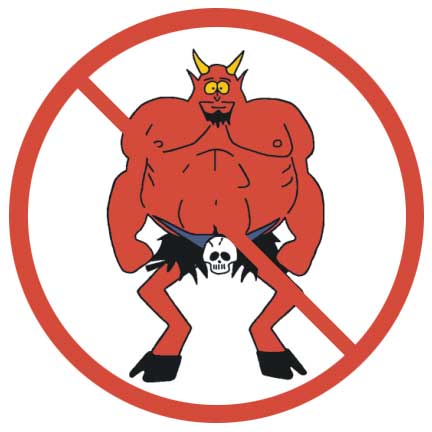
9- Some people are still hung up on linking Paganism, Witchcraft/Wicca to Satan.
Okay, I get where this comes from in the mindset of Christian theology. That’s not the issue, really, as that’s never going to change. There apparently is no real middle ground on which both parties, Christians and Pagans/Witches can meet to understand that Satan has nothing to do with anything outside of Christianity and its offshoots. Satan is a baddie in monotheistic belief systems because of the need for monotheists to make their God an all-loving good guy. Pagan gods aren’t all-loving good guys, we understand that our gods can be pissy and we’re okay with that, so we don’t need anyone to play the Big Bad in our traditions.
8- Witches saying “We don’t even believe in Satan”.
This kind of ties-in to the last one, but I’ll separate it to take it in more detail. I believe that people can create thought-forms and that when lots and lots of people believe in the same thing, they can create it. This is a short and simple definition for how group ritual magic works; it’s not complete, but it’s the basic concept behind it. I’ve seen and experienced its effectiveness and my understanding of things embraces this concept, so to carry that thought forward, I believe that since people have been thinking/talking/fearing/focusing on the concept of a being called Satan, that he exists. You could say people made him what he is. I don’t equate him/it with what he is described as in Christian tradition, but that’s because I’m not Christian and don’t follow that line of thinking or belief. It doesn’t fit with the way I see things. But to say that he “doesn’t exist” seems like a cheap way of avoiding the issue. Sure, I think he exists, and he’s probably got some punch to him as well, given how popular he’s been for several millennia, but I don’t work with him or give him any worship or recognition beyond something of a nod. Just as I acknowledge that there are plenty of other gods out there that I don’t pay homage to, but still accept that they exist in one form or another.
7- Someone saying, “You’re doing it wrong.”
This is bothersome because it reeks of arrogance and posturing by assuming others want to do things the same way you do. This is not the same as someone being well-studied and experienced in an area or practice. Time put in and knowledge gained is worth respecting, if that’s knowledge you want to learn and if the person you want to learn from isn’t a twat.
This also isn’t the same as someone trying to pass along a traditional practice. Things are a tradition because they are handed down intact as they are, with minimal changes in order to preserve their integrity.
What I mean is someone thinking they are the one-and-only-source for knowledge or information and that if you don’t do things the way they tell you to, you’re obviously mistaken.
You must only dress a candle by going from wick to end.
You must only cast a circle beginning in the eastern quarter.
You must only use __ incense when calling for The Morrighan.
If your specific practice or tradition teaches something must be done or used a specific way, that’s fine. You can hold to that, or have and value that, and pass that along to your future students or members of your Tradition. But if someone isn’t part of that practice, you should say, “This is how I do it and how it’s worked for me.” Not, “You should do this like .” Or “If you don’t do it this way, it won’t work and you’ll end up in trouble .” (Ceremonial/High Magick, notwithistanding.)
Everyone’s experiences and background, their personal values, and their needs and desires are different. So is their Craft. One way is not right and true for all. Share what you know with those you deem worthy of the knowledge, but accept that you don’t know everything.

6- Not understanding that The Necronomicon is not real.
Okay, roughly a hundred or so years ago, H.P. Lovecraft was writing horror stories. In his work, he created the Necronomicon for his characters to stumble across and use to get into mischief. The publishers then decided to expand upon that and print up a text to appeal to Lovecraft’s fans. Since the Necronomicon was referenced in his stories, they thought it would be good business to print up a copy of it so that readers could read what the characters were reading in the stories. The Mad Arab, Abdul Alhazred — author of the Necronomicon in Lovecraft’s work— is one of Lovecraft’s characters.
This is the equivalent of J.K. Rowling putting out a printed copy of a spell book referenced in the Harry Potter saga for readers so they could read what Albus Dumbledore may have had on one of his many bookshelves. This does not mean that the book is a real grimoire. Now, since that time, at least one author who also practices magic has been working with the Necronomicon as a basis for ritual magic and has expanded and worked on creating a legitimate spellbook based on the Necronomicon. He has since branched out and done several more FICTION books on the Necronomicon topic.
Please do not pick up a paperback of the Necronomicon and think you are going to summon the Elder Gods. It ain’t happenin’.
5- Empathy is not a special psychic or magical skill. Everyone has it, and if they don’t, they are not a healthy person.
There has been a big push recently to claim empathic talent as a sort of super power. This is ridiculous. You are supposed to be empathetic. Not having empathy for others is the hallmark of a sociopathic person. Now, you may be stronger or weaker when it comes to the in-feeling that people do when they are in one another’s company. Some people become overwhelmed by being around lots of people —or, you may feel drained when you are around lots of people — that’s called being an introvert . Or maybe those other people are just downers who suck your enthusiasm from you. Sometimes other people just suck… literally. Or maybe you are especially sensitive and can easily pick up on what others are feeling, perhaps even to the point of feeling it yourself. That’s empathy, but that’s what happens when you read a book or watch a dramatic movie or television show and feel bad or cry when something sad happens to one of the characters. If you are empathic/empathetic, hooray, you are potentially a well-adjusted human who can show compassion for your fellow creatures.

4- Karma is not what you think it is.
“Karma is a bitch”, “Karma is going to get him/her/them, I will just wait and watch,” and other such pithy nonsense. Karma is an Eastern philosophy and doesn’t actually fit into the concepts of Witchcraft as a Western practice. It was introduced into the Western Mystery Traditions, upon which Wicca partly based, through India being the sparkling jewel in the British Empire. When England had its big occult boom in the mid to late 1800s, people went mad for all things exotic from far off lands. The concept of Karma was thus brought to Europe, but it didn’t really fit. See, in the West, then as now (even more so now, really) we are stuck in a rut of instant gratification. We need to see the results of our actions RIGHT NOW! Otherwise, we lose interest. Karma moves much more slowly than western minds can process, stretching across the spans of lifetimes. It does have connection with the idea of ‘what you sow, you will reap’ but that’s kind of basic, really. I mean, if I’m a nasty tart to you, that’s not going to win me any favors when I need something from you, so I will have earned my ‘karmic retribution’. Except… it’s not actually Karma, it’s just human nature. Karma is huge, and very involved and detailed, and basically of no interest to me because I’m not Hindu or Buddhist. If you would like to know more about it, I suggest that you look in those traditions because in general, the Euro-based systems don’t have a clue about what it really is.
3- Wiccans aren’t supposed to harm anyone/anything, so if you’re Wiccan, why do you eat meat?
This is actually two statements so I’ll give a response for both. Firstly: “Harm None” is grossly misinterpreted and I believe it is misunderstood by the bulk of “Wiccans” out there. The Wiccan Rede (which means advice or counsel and is not a law) says, “If it harm none, do what ye will.” Lots, if not most/all pop-Wiccans (those who have adopted Wicca as their personal religious path without having put a lot of time and study into it beforehand) have latched on to those two words –Harm None– and turned them into an ironclad code of conduct.
That is fine!
I see nothing wrong with people doing so if that’s what they need in order to stick to a positive life path and reach their spiritual bliss. There’s nothing wrong with wanting to live a life without causing harm to other beings, so, I am not against those who follow this interpretation of the Rede. However, my understanding of the Rede is that it says only that if an action harms none, the Witch is free to do it, but it says nothing about what to do or not do if an action DOES cause harm.
Wicca is a religion that is rooted in personal responsibility and accepting the consequences of one’s actions. To me, the stronger, truer meaning of the Rede lays in this understanding.
No one tells a Witch what is right or what is wrong, it is for the Witch to weigh and measure all possibilities and all outcomes before taking action. Each situation has to be looked at and thought through accordingly. This requires maturity and responsibility. There is no one to blame if we do something bad, just ourselves. Every action and every non-action is a choice, and the Witch is responsible for those choices made. If a Witch chooses the path of vegetarianism or veganism, that’s their choice, based on their conscience and understanding of what they deem to be right or wrong. But it remains an individual choice, not one dictated to others.
So, to the second point, taking the life of an animal is not inherently bad. This is because a Witch seeks to live in harmony with nature and the natural order. The natural order says that life feeds on life. So, in order to live, we consume living things — be they animal life or plant life. The animal should be treated well, not cruelly, and its life should end as painlessly as possible for our sustenance. This is the ideal. We should honor this life and its sacrifice and many Witches do this in the form of prayer before meals, and offer gratitude to the plants and animals that have provided our meal.

2- “I want to be a Witch!”
Well, good for you, but I’m one of those Witches who doesn’t think this is a path for everyone. I am happy to help you discover if it’s the path for you, but I do not expect that everyone who approaches me is actually a Witch or will become one. Witches are Witches because they are Witches, not because they want to be Witches. After writing that, I realize how ‘fortune cookie’ it sounds… but it’s the truth. Witchcraft is a deep inner calling. It may be sparked because of books, games, movies, or what have you, but that’s just because it’s a fascinating subject. To actually become a Witch requires devotion, will, understanding, study, patience, practice, and a sense of adventure. I believe that the people who succeed on this path do so because being a Witch is in their nature. If it’s not there, it won’t happen. They may become ‘armchair enthusiasts’ or people who read lots of books, but they will never conjure anything or part the veil between the worlds.
1- Conversion attempts and proselytization.
I’m not just “Not a Christian”. I am a practicing Religious Pagan Witch, priestess, teacher, and devotee of my gods. Someone who describes themselves simply as not being Christian is more likely to be a person with no solid religious or spiritual ideology or practice. The other is one with a committed spiritual ideology or practice.
One is more likely to still be seeking or searching for their particular faith to follow and the other is someone who feels like we found it.
Consider if there would be something that would be enough evidentiary experience, learned knowledge, and practice-informed belief, that would bring you to the point of leaving your faith. Not just question it — because that should be a regular thing you do anyway; questioning and reevaluating — but to actually leave it. If there isn’t, consider that such MIGHT be the same case for me.
Attempts to proselytize or convert me are annoying and offensive, not because I object to the idea of someone wanting to share their faith or experiences, but because of the way it invalidates my own faith or experiences. It’s ALWAYS condescending, even if it’s not intended to be, because it operates on the assumption that I just don’t know any better. That I haven’t thought things through. That I’m not considering all of the possibilities. That what I’m doing is some sort of whimsical phase or fantasy. Or that I’m stupid. All of which are things that are deeply, personally offensive to me.
Nothing shuts down any kind of conversation with me faster than feeling like you think I’m not intelligent or capable of making this choice to the same level, at least, that you are making yours.
If you want to talk about God, history, the bible, faith, religion, etc.
BRING. IT. ON.
Those are legitimately some of my favorite topics of discussion. But understand that I want to share my values, beliefs, experiences, understanding, practices, knowledge, and insight as much as you want to share yours. The difference is, my goal isn’t to convince you to become Pagan or Wiccan.
If it’s not going to be an equal exchange, don’t waste my time. I already know what you’re going to say when you talk about God. But I’m willing to bet you don’t know what I will.
 The Keeper's Path
Visiting from A to Z. I like “Empathy is not a special psychic or magical skill. Everyone has it, and if they don’t, they are not a healthy person.”
https://anneyoungau.wordpress.com/
LikeLike
Very well-written. For number 3, medical professionals are supposed to do no harm, and very often they do harm in hopes it’ll do good, (or because an insurance company demands harm instead… sigh…). So there’s that, too.
I hope you’re enjoying the A to Z Challenge. Please check out the giveaway on my W post.
J Lenni Dorner (he/him 👨🏽 or 🧑🏽 they/them) ~ Speculative Fiction & Reference Author and Co-host of the April Blogging #AtoZchallenge
LikeLike