My short answer to this is: No, there is no difference. Wicca IS Witchcraft. It is not a separate practice that doesn’t use magic. If you aren’t doing magic, or are rejecting magic solely for the religious views and beliefs, then you aren’t practicing Wicca. You are instead practicing Paganism. Wicca is not the only form of Witchcraft, but it is incorrect to say that Wicca is not Witchcraft or that it is not the same thing as Witchcraft. It is.
When discussing the differences or similarity between concepts the first thing one must do is clarify their definition. I use the terms ‘Witch’ and ‘Wicca’ interchangeably, because my personal practice is both. Not everyone does that and there is some confusion over the difference, or in the case of my opinion, the lack of a difference between them.
Wicca and Witchcraft each have two definitions floating around in use. One of the definitions of Wicca is the same as one of the definitions of Witchcraft, one definition of each is different and this is what causes the confusion.
Wicca definition 1: Lineaged, oathbound, mystery tradition popularized by Gerald Gardner. His specific form and the lines descended from him, British Traditional Witchcraft from the New Forest region of England, have specific deities: a God and a Goddess, whose names are known only to members of that group. It incorporates elements of European folk magic and shamanism, Free Masonry, and some teachings of Ceremonial Magick as that was what was understood/popular at the beginning of the 20th century. He added these elements to a system that was already in place to ‘flesh it out.’ He did not create a new system/religion and give it a new name.
Gardner and the others who practiced this called it Witchcraft. The religion/practice was not called Wicca. Being a Witch meant you were “Of The Wicca” or “Of the Wise Ones”.
Wicca means “Witch” in the Anglo-Saxon language and was originally pronounced as ‘Wich-ah”. It is OUR modern version of the word to pronounce the ‘ cc’ as a ‘k’. Wiccacraeft (Anglo-Saxon) is Witchcraft — there is no difference. Wicca is the old Anglo-Saxon word meaning “Witch”. In the Anglo-Saxon language Wicca was the word for a male Witch, Wicce for a female, and Wiccan for plural. One would have said, “Edmund is a Wicca. Eliza is a Wicce. They are two Wiccan.” (It’s not unheard of to use a different ending for the plural of a word in our modern language. An example of this is child does not become childs, it becomes children.)
Along with this, wiccacraeft is the old Anglo-Saxon word for Witchcraft.
Wicca definition 2: Since Gardner’s publications and his putting Witchcraft out there in public, there have been other offshoots who take what they understand to be Wicca, based on the public information (outer court BTW practices) and have developed various other branches of Witchcraft based on Gardner’s original practices. This is how solitary and the eclectic forms of Wicca came about. What ties them all together though is the religious belief in divinity as both feminine and masculine — either as a God and Goddess or multiple gods/goddesses. The importance is that both genders are present, there’s less focus on how both are present. Those believing they don’t necessarily practice Witchcraft see it as something separate, putting Wicca as a religious belief and Witchcraft as a practice fit into this definition. (I do not agree with separating one into practice and one into belief when speaking in terms of religion — this will be explained in a following article.)
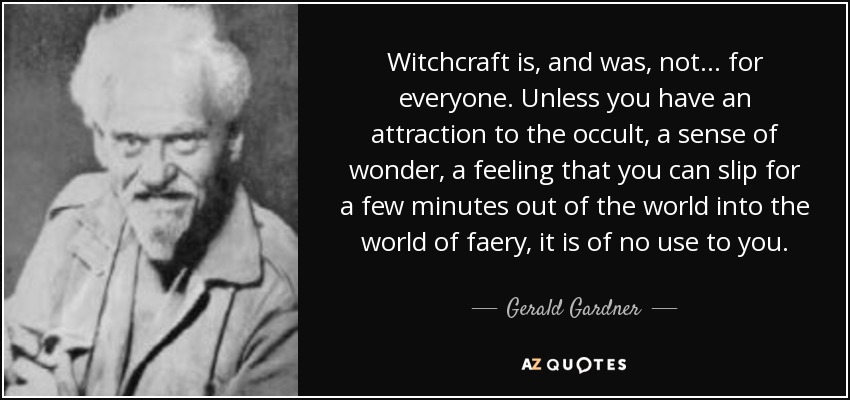
Witchcraft definition 1: The same as Wicca’s first definition. “Witch” is a word in the English language. English is Germanic (Saxon roots) and Latin (Roman influence) When Gardner was initiated, the words used were something like, “Scire, now you are Wicca.” (paraphrasing) Gardner heard that and began spelling what he thought he heard as Wica. The single ‘c’ is what gave the word a ‘k’ sound. Gardner did not invent the word as a term for magical practitioner and he wasn’t the first one to use it in this sense. Ten years before Gardner published anything, J.R.R. Tolkien used the word wicca to describe one of his wandering wizards. Tolkien is known for his scholarship on Anglo-Saxon language so this is a valid hint as to the word’s use pre-Gardner. Gardner and other traditionalists often called their religion and practice “The Craft” or “The Old Religion”, freely using the words Witch and The Wicca to describe the same thing Mike Nichols, a well-respected elder of Wicca and Paganism has this to say:
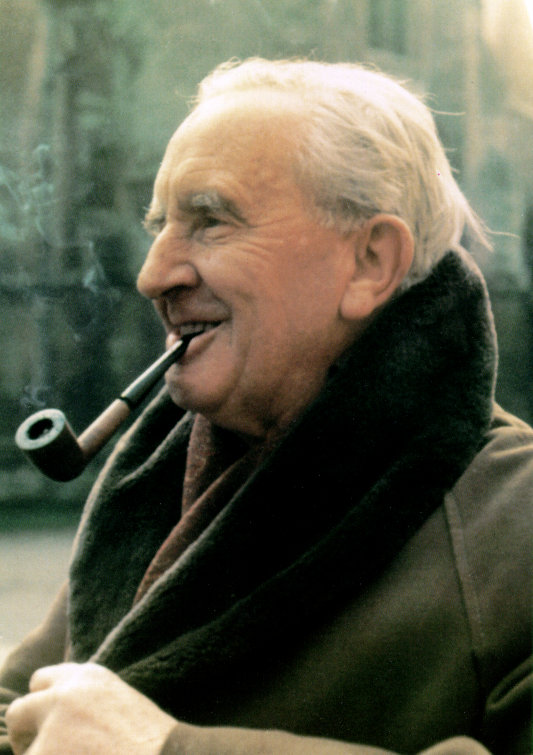
Witchcraft continued to be known in its earlier form, wicca, even before Gardner came onto the scene. One quick and obvious proof of this is that J.R.R. Tolkien, author of The Lord of the Rings trilogy, used the word wicca when drafting his earliest manuscript of The Two Towers. We know this because Tolkien’s son Christopher has meticulously documented his father’s creative process throughout twelve volumes of analysis. In volume seven, “The Treason of Isengard”, Ch. XX, “The Riders of Rohan”, Christopher mentions, in a passing footnote, that Tolkien uses the word wicca apparently to identify the characters Gandalf and Saruman, who were otherwise called wizards throughout the trilogy. The word wicca is written in the margin next to the scene discussing the identity of a mysterious old bearded man wondering Rohan. Tolkien was writing this draft in 1942, ten years before Gardner published his first treatise on Wica. So it is impossible for Gardner to have influenced Tolkien’s use of the term. Nor did Tolkien influence Gardner, since this marginalia was unpublished. These were totally independent uses of the same word by different authors working in different fields, with Tolkien giving the more common spelling a full decade before Gardner.
Tolkien is well-known for his scholarship of the Anglo-Saxon language. If he used the word Wicca to describe a character a full ten years before Gardner first came forth and the two had no influence upon one another, then Gardner and his descendants do not have sole claim to the word. Gardner did not invent Wicca, as detractors try to claim. He added to it and publicized it. Someone was doing magic and witchcraft in England when Gardner came into it. He worked with them, building it up and creating what we now know as Wicca. We as modern Witches owe him a great deal for doing so.
Witchcraft definition 2: As English speakers, we’re using an English word to describe what it means to people rooted in the English culture. Witchcraft has been used to describe works of magic, folk medicine, shamanic practices, spirit communication, etc. because that is what the ancient people of Europe and specifically the Anglo-Saxon areas (northern/western/British Isles) used. It’s the way “witch-doctor” was used by English explorers as a label for African tribal magic-users.
This is why people say that the word witchcraft can be applied to any practice that follows these without the involvement of Wiccan or Euro-Pagan beliefs/religion. This is where groups or people fit if they claim they practice a different brand of Witchcraft that isn’t Gardnerian or other Traditional systems. The “I’m a Witch, not Wiccan” fits into this area because they believe the word Wicca is only for those of a Gardnerian mindset/lineage/heritage. If you’re a Russian or Slavic Witch, an Italian Witch, a Germanic Witch, a Spanish/Hispanic/Latin Witch, or some other culture that has its own practices of folk magic and pagan traditions that is not built upon or based in Gardnerian Craft, then you’re not a Wiccan.
But remember: Wicca means Witch — there is no getting around that.
Witch is an interesting word. Given its Proto-Indo-European root, weik, it means one who is wise, who can bend and shape energy and manipulate it.
A Witch is someone with the knowledge of the earth, plants and herbs, stones, sacred places, and spirits. Wicca also shares the same root as ‘wicker’, meaning something created from twisting or bending straw. A Witch is someone who understands these natural forces and energies and works in communion with them, twisting or bending them. Traditionally, this might have been done for the good of the people in the community in which the Witch lived. Witches were similar to and sometimes could serve as shamans, midwives, counselors, cunningmen, folk-healers, seers, and diviners.
If you are Wiccan you are a Witch.
If you are a Witch utilizing Gardner’s stuff: the quarters, elements, circle, God and Goddess, the eight sabbats, then you are probably practicing Wiccan Craft. Your witchcraft might have differences than the system Gardner popularized and developed, but by definition, it’s Wicca.
 The Keeper's Path
incorrect. wicca and witchcraft are two different things. get educated.
LikeLike
Hi RPP —
Tell me you didn’t read my article without telling me you didn’t read my article. 🙂
LikeLiked by 1 person
Good article.
All Wiccans are witches, but not all witches are Wiccans.
Ergo, witchcraft is the overarching category, and Wicca is a subset of it. And Gardnerian Wicca, Alexandrian Wicca and other traditions are subsets of Wicca.
LikeLike
Hello Yvonne,
Thank you for taking the time to read and comment. 🙂
LikeLike