

Mentioning the words Demon, Demonology, and perhaps less often Demonolatry, conjures all sorts of fear-based reactions because of what these words have come to mean to most people across time. Many will choose to avoid the topic all together, stating that anything having to do with demons is evil and dangerous.
People say the same thing about Witchcraft.

However, just as it’s important to learn what Witchcraft is truly about and how it is fully practiced to make an informed judgment, the same can be said for demons and their related studies and practices.
If you learn about Witchcraft, you may determine it’s not something you want to engage in or do. You might even decide that in your understanding, no one should engage with it or do it.
Both of those are valid conclusions to reach after you’ve learned about it and can make an informed decision.
The same applies to demonology and demonolatry. No one is saying you should study demonology or practice demonolatry. But, if you’re going to explore occult topics, for any reason, you should know what they are.
I am not writing this article to explain how to engage in either of these areas, nor am I going to offer instruction on how to do it. I am providing information about what these are in an effort to dispel misinformation and encourage accurate study if either of these areas interest you.
As with any and all things in magical, spiritual, or occult areas, I will offer this solid advice:
Learn about something before you attempt to do it,
And
Do not summon what you cannot banish.
So, let’s explore the similarities and differences between these two things. The word demon originates from ancient Greek philosophy and mythology as daimon (or daemon). It’s a term that refers to a kind of spirit or supernatural being, often considered to be an intermediary between gods and humans. Characterizations of the daemon as a dangerous, if not evil, lesser spirit were developed by Plato and his pupil Xenocrates, and later absorbed in Christian writings along with some other Neo-Platonic elements.*
The meaning and significance of a daimon can vary depending on the context.
A Daimon/Daemon/Demon is a powerful spirit or entity, not as high-level as a god, but generally understood to be more powerful than a human.
The terms demonology and demonolatry both deal with demons, but they approach the subject in different ways. Here’s a breakdown of their differences:
Demonology

- Definition: Demonology is the study of demons, their origins, behavior, classification, and the impact they have on humans and the world. It is an academic or theological field that looks at demons from a more neutral or scholarly perspective.
- Focus: Demonology primarily focuses on understanding demons, their roles in various religious and cultural contexts, and how they are depicted in literature, mythology, and religious texts. It often involves the study of historical texts, folklore, and scriptures like the Bible, the Quran, and other religious documents.
- Perspective: Demonology is generally non-practical and does not involve the worship or veneration of demons. It’s more about research and knowledge of demonic entities, their characteristics, and how they have been viewed throughout history.
- Example: A person studying demonology might look into the different demon hierarchies described in Christian or Islamic traditions or investigate the psychological and cultural aspects of demon encounters.
Demonolatry
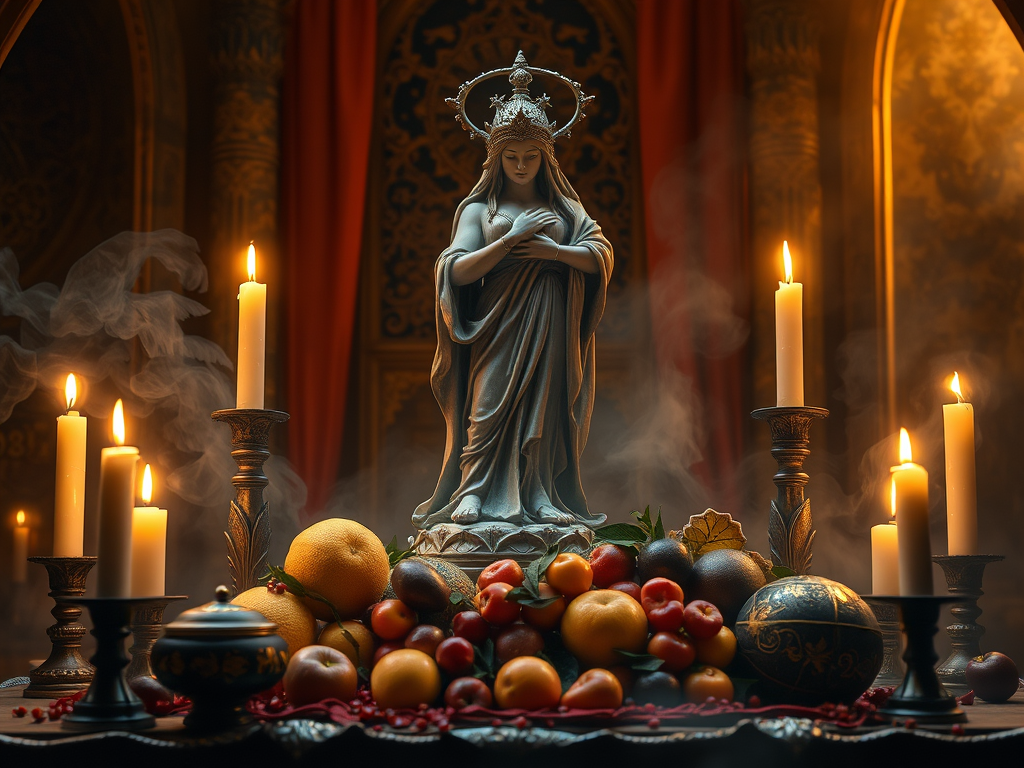
- Definition: Demonolatry is the practice of worshiping or venerating demons. It is a religious or spiritual practice that involves the active honoring, invocation, and sometimes the worship of demons as deities or powerful entities.
- Focus: Demonolatry is about the worship of demons, either individually or as a pantheon, often seen as beings who can offer power, knowledge, or protection. This practice may be tied to a belief system that views demons not as inherently evil but as entities that can be respected, worked with, or even worshiped.
- Perspective: Demonolatry is a more practical and experiential approach, where practitioners may engage in rituals, prayers, or offerings to demons, seeking their aid or guidance. It can be seen as a form of spirituality that aligns with more occult, esoteric, or non-mainstream belief systems.
- Example: Someone who practices demonolatry may invoke a demon like Baphomet or Asmodeus during rituals, offering respect or invoking their influence for personal growth, power, or other purposes.
Key Differences in Summary:
Demonology is the study of demons, often in a scholarly, neutral, or theological context.
Demonolatry is the worship or veneration of demons, typically involving rituals or personal spiritual practices.
Like many things in magical or occult tradition, there are numerous misconceptions about these.
Demonology/Demonolatry is the same thing as Satanism – No. While there can be some overlap between Demonology/Demonolatry and some forms of Satanism, they are not interchangeable terms. Satanists may certainly choose to study or practice one or both of these. Or they may be Satanists without engaging in the study of or veneration of demons. Likewise, one may study demonology, or practice demonolatry without involving Satanism at all.
In my experience, 80+% of books written on Demonology are done so from a Christian perspective. So, it’s often a topic of study among Christians rather than occult practitioners.
Demons are all evil – This answer varies depending on who you ask, but from a historical and philosophical understanding, the answer is no. Most demons classified in both demonology and demonolatry are considered neutral, or even beneficial in nature. Many of the beings classified as demons were given that label and given the forced attributes of being evil by competing religious beliefs or systems. As in, “If you’re not with our god, you’re against it. Since our deity is right/good/just then if you’re against it and honoring demons, they must be wrong/bad/wicked.”
Demonolatry is by nature, dark or malevolent – Not true, in that it has no inherent nature towards anything, either helpful or harmful. Like many occult practices, it depends on the individual intention of the practitioner where they will direct their focus and to what end they seek to accomplish a goal. One could work with a demon to increase the health or wealth of themselves or a family member just as they could work with a demon to decrease those things. It depends on the intention of the practitioner, which demon they want to connect with, and how they want to utilize the power in that relationship. Again, the broad-stroke linking of demons with evil comes from outside sources who seek to demonize — think of what that word actually means: to call something evil in an effort to change its reputation — occult practices and beliefs.
Demons only exist in Christianity and within Christian beliefs – False. Demons exist in many religions and spiritual systems across vast cultures and nations. Because of this, demonology varies widely across the world and throughout different periods of history. One tradition might fear a particular demon, while another tradition might honor it. In the western world, we’re most familiar with the concept of demons in Jewish and Christian tradition, thinking of them as fallen angels.
This link offers a good list of demons from different cultures and these are some specific ones:
Islam: Demons are called Jinn and are created from fire, while humans are created from clay. Some Jinn are good, but others are evil and can cause harm.
Hinduism: Demons are known as Asuras, who are often depicted as enemies of the gods and are associated with chaos and destruction.
Greek Mythology: Demons are often depicted as malevolent spirits or deities, such as Lamia.
Japanese Mythology: Demons are known as Yōkai and are often depicted as mischievous or harmful spirits.
Zoroastrianism: The Zoroastrian religion has a figure named Angra Mainyu, who is the embodiment of evil and is seen as the adversary of Ahura Mazda, the god of Zoroastrianism.
Mesopotamian Mythology: Demons are known as Qatû and are often depicted as malevolent spirits that cause sickness and death.
Slavic Folklore: Demons are known as Vampires and are often depicted as malevolent spirits that feed on the blood of humans.
Engaging or working with demons is dangerous and will lead to harm or possession – Not necessarily true. Possession is its own topic of discussion and need not be a part of demonolatry ever. It’s also overly-sensationalized due to media, and the feeling of being something restricted, forbidden, and dangerous. All religious or spiritual practices have some level of harm or risk associated with them, but with protective measures, education, positive intent, and experience, many people find a beneficial and productive relationship with these beings is possible.
One last popular misconception is that many believe that a person must be naturally gifted or psychic to develop the skill of working with demons. This is not necessarily true. Just as many will say that in order to be a witch, you must be born with a level of natural psychic ability or talent, there are just as many who believe that you can study and practice in order to become proficient. Yes, natural skill or talent might give someone a head-start on working with an occult practice, but that doesn’t mean if you don’t have the same head-start, you can’t put in the work to achieve your goals.
Demonology is an interesting and intriguing journey into history, human psychology, and understanding religious influence on people across various cultures. It’s also highly recommended if you want to pursue Demonolatry, you are at least studying and learning about Demonology before or with doing so in order to have a fulfilling, productive, and healthy practice.
*See especially Plutarch – On the Daimonion of Socrates. For the daimon in Middle Platonism, see John Dillon, The Middle Platonists: 80 B.C. to A.D. 220. For the daimon in Neo-Platonism, see Gregory Shaw, Theurgy and the Soul: The Neoplatonism of Iamblichus (I couldn’t find an online copy of the book, so this is a podcast interview where Dr. Shaw is explaining the concepts in his book.)

