
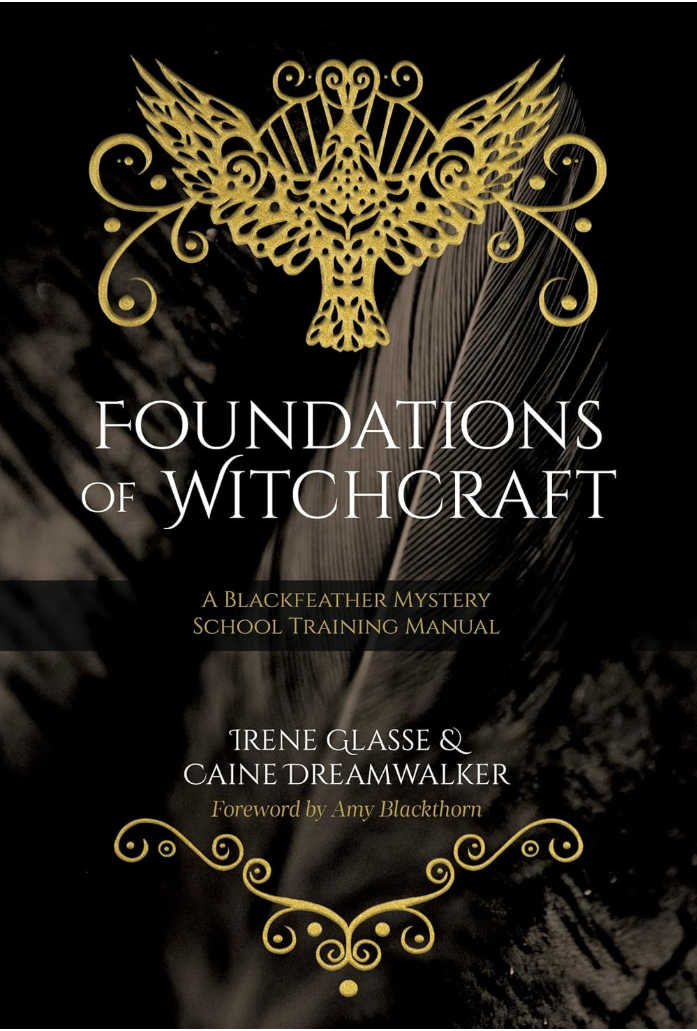
Title: The Foundation of Witchcraft – A Blackfeather Mystery School Training Manual
Authors: Irene Glasse & Caine Dreamwalker
Genre: Spiritual/Magical Training and Education
I received a free copy of this book in exchange for an honest review. I did not receive any sort of payment for this review. This is my opinion of this author’s work and not a paid advertisement for this book.
I was excited to receive this book and spent some time with it going through a couple of the exercises in order to really get a feel for what the lessons encompass.
I was not disappointed.
As a teacher of magic and Witchcraft as well as being a priestess functioning in a clergy role for my coven and community, I am always interested in finding materials that can provide more practical education and enhance our practices.
This book does that.
When I first received the book, I did what I always do when examining a book for content and interest. I flip through it to see what catches my eye. I think: if I were browsing in a bookstore, is this something I would take home?
The answer to this is a resounding “Yes!”
The first thing is that it has HOMEWORK, which if a book claims to be a ‘training manual’ is imperative to include.
It’s also what I spent most of my time doing before I reviewed this book, because if I am going to praise or critique something that claims to serve in this way, I want to know if I would use it for my own students, adapting it to our structure or keeping it as it is.
The authors have a very solid system that flows in a natural progression through the lessons. They provide solid basic references for correspondences like colors, oils, scents, etc. but then expands on those basics for the practices that really help a beginner find their feet: grounding, centering, meditation, pathworking, guided visualization — the things that make magic go.
I worked through a couple of the practices and my favorite at this time is the focus on the Elemental Voice.
Utilizing sacred voice is a technique I learned many years ago. It is one of those things that I put into a category of ‘triggers’ that can be pulled out of a magical toolkit at any time, because unless there is a reason you are unable to speak, it can be used instantly.
The authors have a style of assigning different tones to the elements. As a coven leader and public speaker, I have used these techniques in my own practice, but did not have the name for them that the authors provide. This makes teaching these techniques so much easier, and because I know they work, I have absolute faith in how the work is presented in the book as guidance for my own students and for keeping in mind for my own work and use.
I’ll give an example from the book.
This is the Earth Voice:
Earth Voice is low, slow, and steady. The melody of the voice stays towards the low end of the vocal register. Words are delivered firmly and clearly. Earth Voice is a good choice for guided meditations, calming, and focusing people.
The other exercises and practices in this book are laid out in a clear fashion, making them easy to understand and put into use. I could see this book being both a valuable tool for self-guided study, because it is presented as a lesson-based workbook, and also see it being used in group practice for a study group or circle, or in cases like mine, adapted for lessons in the coven.
There is so much to be said that I could seriously gush over this title for hours, but I’ll leave this with one other major bit that really impressed me.
In the Craft, in spiritual spaces, there is a horrible trend leaning now towards racial/ethnical discrimination and abuse. The most openly known of this infestation has been seen in the Norse/Asatru paths who have added an element of white supremacy to their persona.
There is a section in this book on how to watch out for those, because a new seeker who is coming into this world of spiritual beauty is not necessarily going to expect that something that publicly speaks of ‘light and love’ would harbor such disgusting beliefs.
But it does. We have our share of abusers, violators, and racists because people are people. And because Pagans are people, we can all say, ‘They’re not welcome here.’ or ‘They do not represent who we are’, but we cannot say, ‘They don’t exist.’
This book gives insightful guidance on how to source magic and groups safely and specifically advises what to look out for in terms of Nazi dog whistles.
That hit me hard and even if I had found no other reason to recommend this book, that would be it.
One of the first lessons I give students is an understanding of critical thinking and knowing how to evaluate a source for credibility: whether it’s a book or a person. This chapter goes into that same detail, advising how to judge things based on critical merit, the differences between an Unverified Personal Gnosis and an academic source — and what value can be found in each.
This book aligns with much of my own practice and educational background. For that reason, and for many others–found in the table of contents–you would likely understand why I recommend it so highly.
If you like my blog, or if we have ever spoken and you gained anything beneficial from that, then definitely look at this book.
I am not a member of their tradition, but I think that the authors and I would enjoy chatting over a cup of tea.

